Tuesday, 14 January 2014

The Reach of Rome


The Reach of Rome by Alberto Angela is a scholarly, yet accessible story of the Roman Empire and its legacies. The author weaves his story around real people (cemeteries), real buildings (archeological digs) and real social customs (documentation and artifacts). He takes us on a journey through the Empire as we follow the course of a coin, hand-over-hand, in the year 115 CE Rome under the industrious ruler, Emperor Trajan.

The story is described as "cinematic".  It moves back and forwards in time, allowing readers to imagine themselves in the same spot. This literary time machine is a must for the serious traveller who enjoys walking in the footsteps of the past, to see a glimpse of the future, which is ours today.

Alberto introduces us to exotic places, smells, customs, dangers, banquets and legionaires on the march. He takes us in to battle, the arms of prostitutes and gambling dens; has us ride with charioteers, partake in religious sacrifice, medical treatments and business dealings; and the way of life of the rich and poor.

The coin, we will follow is first struck in the Roman Mint by slaves. It is decorated on one side by the head of the ruling Emperor and on the other side a picture (such as a new bridge) advertises to the people across the breadth of the Empire of his achievements. It is an early and effective form of propoganda.


"The Roman Mint is a real inferno in the vicinity 
of the Colosseum." p13


The coins are then transported by military couriers in saddlebags on the backs of horses and are quickly and efficiently dispersed to forts, governor's seats, provincial capitals, economic centres and miltiary posts. Today, these same routes are commandeered by armies of tourists - Rome, London, Paris, Trier (Moselle vinyeards), Beyond the Rhine, Milan, Reggio Emilio, Rimini, The Tiber, Circus Maximus, Ostia, Spain, Provence, Baia, The Medoterranean, Africa, Egypt, India, Mesopotamia, Ephesus, Capadoccia and back to The Eternal City.

The story begins in Rome with a young woman scurrying, dressed anonymously in robes, along the streets to the den of a witch whom she will pay to put a hex on her husband. This social custom was well-documented by Professor Marina Piranomonte when the Sacred Fountain of Anna Perenna, in the Parioli neighbourhood of present day Rome was unearthed when an underground garage was being built. Many of the offerings, like this young woman's, were thrown in to this fountain.


"Digs uncovered objects connected to magic, rituals and hexes." p8


Anna Perenna had an erotic cult following;


"Banquet tables were set along the Via famina where they sing, dance, get drunk and have sex." p8


And so the newly-minted coin (called a sisterce) begins its round trip over The Alps,  across the English Channel landing in Dover and on to the outermost edge of the Empire near Hadrian's Wall. But the squadron of horseman do not see Hadrian's Wall because it has not been built. These men serve Emperor Trajan and it will only be when he dies and is replaced by Hadrian 40 years hence that work on the wall will commence to keep the hostile Scots at bay and protect the legionaires from attack.

It is the second century after the birth of Christ and London is still a village. There is no Big Ben, Buckingham Palace or Westminster Abbey - just countryside. But there is a bridge spanning the Thames in the same place that London Bridge stands today. The Roman's gave birth to London and built the bridge at its narrowest point and deepest dock for trade.


Many of the the foundations of our modern society were laid down by the Romans and the author points to the uncanny use of some prominant places that have been used over and over again by successive generations of mankind.

Rome also gave birth to Paris, on The Seine and the Ille la Cite. The person who now has our coin in his pocket stands on the site of Notre Dame which won't be built for 1000 more years. But he does see the Temple of Jupiter that first stood on this site, which will be replaced by a christian basilica, and a Romanesque church until tourists finally throng around present day Notre Dame.


The Romans left many legacies, inventions, building and artworks but its most enduring is the 80,000 kilometres of sturdy, well-engineered roads that connected millions of people. These roads were marked at intervals by pillars that told the traveller the distance. The zero point of the Empire can still be seen near the Statue of Augustus outside the Roman Forum.


These roads were travelled on foot, hitch-hiked and used by wagons pulled by mules. Horses were expensive and used only for war, hunting, chariot racing, couriers and the postal service. Many of these horses were sourced from Capadoccia in Turkey, which when translated means 'land of the beautiful horse'.

Taverns dotted the highways and provided light snacks such as ricotta cheese on foccacia, wine, prostitutes, animal feed and shelter. Food and superstition dominated the lives of Romans as life was fragile. Food was symbolic in celebratory banquets, thanksgiving ceremonies and religious rituals. Licentiousness and debauchery gave relief from the uncertainty and harshness of everyday life.


"There is nothing better than a honey-filled foccacia dipped in milk to start the day." p282


And what was on the banquet menu?


"Wild boar, roasted doormouse dressed in honey and sesame seeds, snails, flamingo, peacocks, eel and sea bream." p308


Wine cups unearthed at the vineyards in Moselle depict scenes of banquets and toasts. Engravings such as "To your Health" are still common in our time and epitaphs found on cemeteries share the same humour and laments.

"Battles, wine and Venus ruin our bodies. But baths, wine and Venus are what life is made of."

Life was short and health was unpredictable. Death came early from war, childbirth, disease, accident, murder, overwork, slavery, shipwreck and superstition. Despite this fragilty how did Rome endure for so long?

Firstly, it offered incentives to soldiers and slaves. Solders who fought and lived were granted citizenship and land, slaves were granted freedom, coinage encouraged financial opportunities to those loyal to the empire.


"Roman coins have been found as far away as the Mekong Delta in Vietnam and the northern tundra of Afghanistan." p19


Roman emperors also exploited "bread and circuses" by providing free grain to those who needed it and entertainment at the Circus Maximus. The Circus Maximus held over 200,000 people (the Colosseum only held 80,000) and operated continuosly for 1200 years. Around it sprang shops that sold cushions and parasols, cheese and pickled fish. Our coin now passes in to the hands of the gambling dens where a bet is placed on a favourite charioteer. Customers can be seen gathering early for a day at the races. They bite in to grilled sausages or a foccacia bun. They are served with a hot beverage of wine, diluted with water and scaldingly hot.

Coffee comes to mind but it is 117CE and the author tells us that coffee beans are still growing wild on the hills of Ethiopea. It will be another 1000 years before the streets are filled with the familiar aroma of Italian expresso.

The greatness and glory of Rome also had a dark side. Millions of exotic animals, many lost to extinction were captured and slaughtered for entertainment. The superstitious nature of the Romans also included the cruel daily sacrifice of bullocks, sheep and birds. The distribution of wine called "nectar of the gods" drugged an entire Empire. Rome also denuded vast tracts of land for their building programs, crop growing and mining for gold. Its engineers not only diverted river systems but were able to bring down entire mountains without explosives.

But back to our coin. It has made the round trip back to Rome  After a year-long journey around the Empire the coin's journey ends - for now. 

It is the custom of the Romans to place a coin (sisterce) in the mouth of a deceased person to pay their way in the afterlife and this is what happens to our coin. However, the light will shine on our coin once again when the body of the man it rests with is unearthed by future archeologists. 

But all you need to know for now, is that the hex at the start of the story worked!


And now for some historical recipes inspired by the book Around The Roman Table. Food and Feasting in Ancient Rome by Patrick Faas.


Ovis Hapalis (Latin for boiled egg) 
served with Julius Caesar's favourite sauce


200 gram of pine nuts 
(soaked in water for 1 hour and drained)
2 teaspoons pepper
4 tablespoons honey
4 tablespoons of anchovies
2-3 teaspoons of white wine vinegar. 
(I used red Cabernet Vinegar)

Blend and serve. Really yummy!


Columella Salad


100 gram fresh mint
50gm fresh coriander
50gm fresh Italian parsley
1 small leek finely sliced
Sprigs of lemon thyme
Crumbled salty cheese ie fetta
I also added cubed cucumber
A sprinkle of vinegar 
(I used cabernet red wine vinegar)
Splash of olive oil
Salt to taste.

Chop. Combine. Enjoy.


            ©2011 My Novel Idea by Ann Etcell-Ly/All Rights Reserved

Thursday, 21 November 2013

The unauthorised history of Australia

Girt  by snarky David Hunt has re-written Australian history from Megafauna to Macquarie in masterly antithesis sort of way.


It is caustic, satirical and mocking of the "royalty" who first surveyed, plundered and settled our "wide brown land" just over two hundred years ago. Even if you are offended by his "take" on the country's history he won't mind as he is very capable of having a good old belly-laugh on his own. In fact he has done just that by writing another volume.


The book is dedicated "For those who come acrosss the seas" and I surmise this is not only a nod to the people he lampoons in Girt, and to all of us who have a bit of "fookin eejits" in us, but it also meant for future Australians. Although one wonders what these new Australians will think of the "history" they have inherited?


David Hunt begins at the beginning. The first two chapters set the tone for the book with his explanation of Foreigners and Aborigines. With that out of the way he says he can now start with the real stuff, 


"jolly convicts, villainous governors, rum, squatting with sheep, rum, gold diggers, token women, rum, geographically-challenged explorers, plucky Irish outlaws and rum".p49


But I am getting ahead of myself. First, Hunt tells us about the advantages of being "girt by sea" and how this "phenomenal girtage" kept Australia incognito for tens of millenia. It was this "girtuosity" that allowed Aborigines their nomadic way of life for 60,000 years where "not much happened besides some finger painting" and who are the original, "un-original non-inhabitants" who did not exist until Mabo and the High Court of Australia said they did in 1992.


"Black people had been hiding in our backyard for 
60,000 without paying rent." p31


While Captain Cook is credited with discovering our "Great South Land" first, which by the way, was proposed by Aristotle; the Spanish, Portuguese, Dutch East India spice traders, French, Chinese, Indonesians had all dipped their big toes in to Australia's blue waters and lost many sailors to the scourge of scurvy and disease. They decided, like Abel Tasman who discovered Tasmania, not to embark due to the "lack of facilities."

Due to Australia's isolation Hunt refers to us as "giant petri dish ...that was able to grow a unique culture".

"In time, a new and distinct people emerged from Britain's colonial kitchen...a people who bathed regularly." p3

While previous explorers had dismissed Australia for its isolation, Britain embraced it. It needed a place to stash its upsurge in undesirables due to the Industrial Revolution and America's petty refusal to pay tax on tea or take any more convict imports. 

"Britain fervently hoped that the tyranny of distance and the despotism of lots of water would prevent its undesirables from walking back to London." p2


The mad romp through recent history now turns to Captain Cook who "drove the boat" for his plant buddy Joseph Banks. We have Arthur Philip who believed in the sharing of scarce resources when he discovered that Australia was not the "land of milk and honey" and Banks, who had recommended it was a "lying bastard."

Unfortunately, Arthur Philip's socialist policy was quickly undermined by the entrepeneurial Macarthur.

"An early investor in the (rum) corps racketeering, but his real money came from privatising NSW." p144


Rum was both the drink of choice and the currency of the fledgling colony. It even built the colony's first hospital which is now the NSW Parliament in Macquarie St, Sydney.


"The convicts gratefully received their wages by the bottle and bundy on as soon as they bundied off." p153


This riotous behaviour continued until 1794 when England, weary from war with Napoleon, turned its attention back to the colonies and a crackdown on licentiousness, profiteering, hypocrisy and rivalry amongst its governors and citizens and the rest, as they say is... er, history.


No scurvy Orange Cake


2 medium oranges
2 cups self raising flour 
(or 2 cups of almond meal and 1 teaspoon of 
baking powder if you prefer)
1 teaspoon organic vanilla essence
4 eggs beaten
1/2 cup of sugar 
(or one cup of sultanas for sweetness)


Method


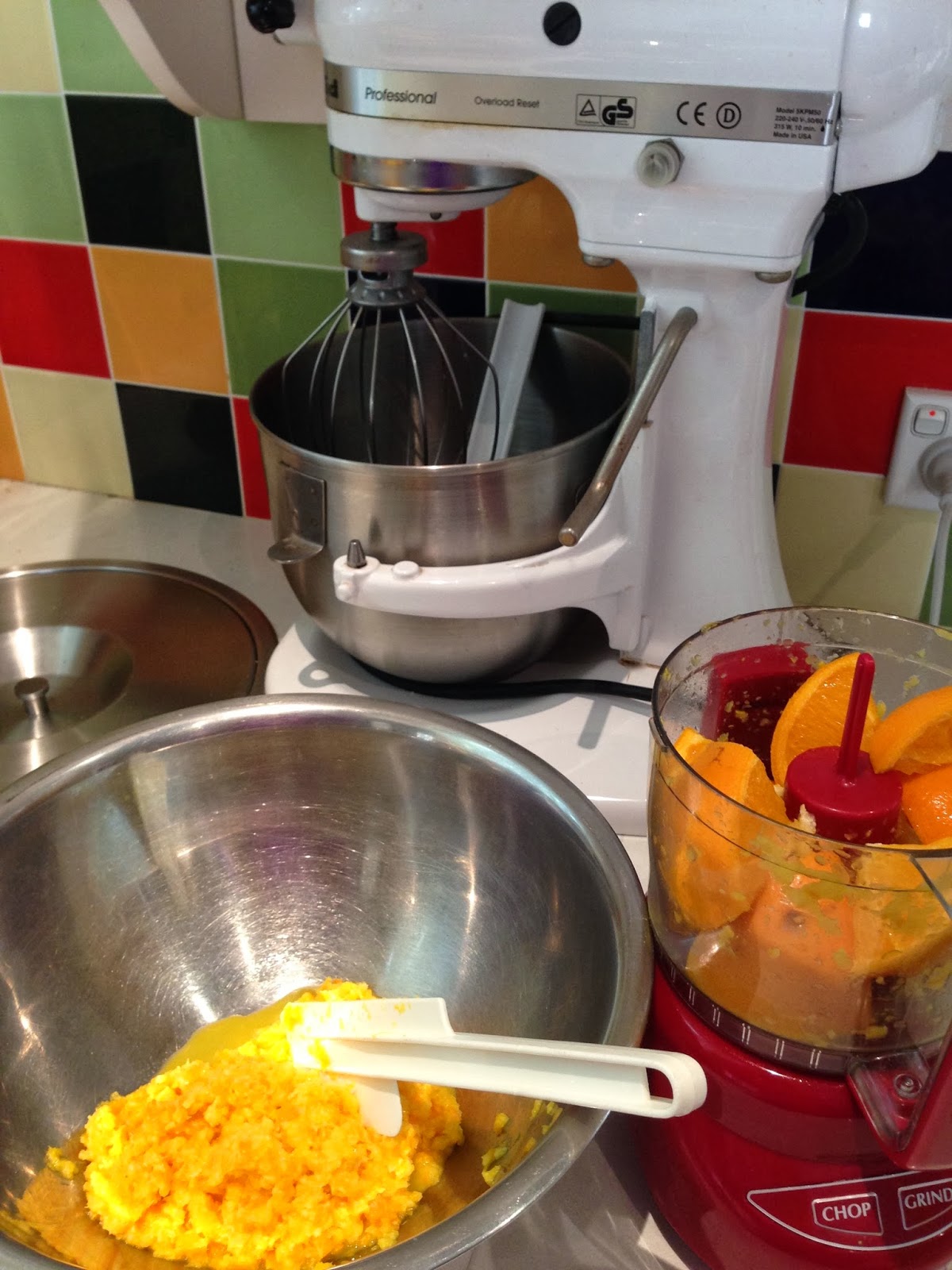
Boil two whole oranges for 45 minutes. Remove the oranges from the pot and allow to cool. Once cool blend whole oranges to a pulp. To the orange pulp add 2 cups of self-raising flour, half a cup of sugar and 4 beaten eggs. Pour in to a prepared loaf pan and bake at 180 degrees for 45 minutes or until a skewer comes out clean.

Alternatively, replace the flour with the almond meal and a teaspoon of baking powde; and the sugar with sultanas. I have done it both ways and it always turns out. Tastes great with a spread of butter (or not) and a shot of spiced rum (or not) and a cuppa.


             ©2011 My Novel Idea by Ann Etcell-Ly/All Rights Reserved
                    GIRT by David Hunt 2013 ISBN 9781863956116

Saturday, 16 November 2013

A Pedestrian in Paris


What could be better on a rainy Sunday than a 
good book and the smell of cooking?


The most beautiful walk in the world
by John Baxter


When you have lived in Paris for twenty years and walked in the footsteps of the famous and not so famous, what would your most beautiful walk in the world be?

John Baxter is the son of an Australian pastry chef, who married a French woman Marie-Do and settled in Paris to bring up their daughter, Louise. He is both an author of several books and a bloke who does walking tours with a focus on the haunts of literary artists and good cafes.

He lives on the rue de l'Odeon - a pedigree street where Sylvia Beach ran Shakespeare and Company, the bookshop that published James Joyce's Ulysses. Also out and about were notables Scott and Zelda Fitzgerald, Gertrude Stein, Alice B. Toklas and Ernest Hemingway.

Between 1918 and 1935 Parisians shared their footpaths with Salvador Dali, Pablo Picasso, Man Ray, Magritte, Matisse, Toulouse Le Trec, Andre Breton, Djuna Barnes, William Faulkner, e.e.cummings, William Carlos Williams, and scores more attracted to the bohemian lifestyle, Montemartre and the Left bank.

John says that when he steps out of his building, tour groups on the opposite side of his street, who are being lectured in any of a dozen languages, view him with curiosity.

"I feel like a fraud," he says, "instead of thinking lofty thoughts, I'm compiling my shopping list...onions, eggs, a baguette..." p2.

Paris is a walking city. Parisians walk everywhere because, as John explains, Parisians regard their city as an "extension of their homes". It is their habitat - their quartier. Paris belongs to the pietons - the pedestrians. Even during the French Revolution angry mobs walked the ten miles to the Palace of Versailles to rattle the gates.

Everyone who comes to Paris, he says, will soon discover their own "most beautiful walk and their own favourite cafes, shops and parks and the routes that link them".

According to John, the average parisian "walks briskly and erect despite their breakfasts of croissants, foie gras, fried potatoes, steak, red wine and cheese" and he compares this to the physical state of Anglo-Saxon expats who are "pale, slouching, sagging." Also in the author's sights are other notable wrecks of the past such as "obese Gertrude Stein, the permanently sloshed Fitzgerald's and Henry Miller and the shuffling James Joyce. 

But one wonders, how did this Paris come about?

John explains, look no further than Napoleon. He is the one who ordered Paris to be re-built and styled by George Haussmann, who tore down festering alleyways, displaced citizens and replaced all with boulevards that formed the pattern of a star with the Arc de' Triomph at its heart. A city where no building was permitted to be built higher than the width of the boulevard, thus ensuring a city of human scale, tree lined and sunny.

"Wide clean streets encourage walking and a cafe culture on the pavements 
and the parks for strolling couples, baby carriages and picnics".


The only folly is tower block of Tour Montpanasse built in 1960 by President Pompidou. The locals have a joke about this tower block. From the top of its 60th floor, one can see all of Paris - except this building. See below.


John who caters to the curiosity of cultural tourists describes tourists in general as:

"Hundred of couples who pass me by every week, dressed in their burberrys, sensible shoes, 
distracted expressions and a much folded map."

The least offensive, he informs us are those (tourist guides) represented by an umbrella or flag raised, 

"Whom I saw every day leading bedraggled crocodiles of visitors up and down."

John tells us the best way to know Paris is through our senses, where France serves its very essence 
on a plate and the country's food speaks an international language.

"Seduction often begins with taste." p162

In Summer, we are told, "the cafes of Paris fold back their glass walls, so that one sits on the sidewalk with pedestrians brushing your tiny table, sometimes rattling your eau de menthe or jangling the coffee cups".

"...and few pleasures are more satisfying than strolling through a French market on a sunny day." p224

He urges us to "eat like the French do."

"A true French cafe breakfast remains one of the great pleasures of life in Paris - fresh coffee, croissants, brioche, baguettes still warm from the oven." p289.


Joi de vivre - arty, seedy, literary, revolutionary; scarred by war and rioters and invaded by tourists, what is the author's most beautiful walk in the world? Towards the end of the book, you will see it. A picture of John walking hand-in-hand with his baby daughter.


The story starts off with John, who is in charge of Christmas dinner being locked out of his house. This is not a good thing since the only time Paris is not a walking city is when it is blanketed by snow and all of Paris is quiet. Many leave Paris at this time. But all is well. The lock gets fixed and Christmas dinner of turkey, perfect roast potatoes, carrot and turkey gratin, foie gras, cranberry sauce and confiture d'oignons is served. 


French Onion Marmalade
Confiture d'oignons. 

Makes 300ml.

1 kg onions (red or white)
100ml olive oil
1/2 teaspoon black pepper
2 bay leaves
2 sprigs of rosemary
150gm soft brown sugar
75ml white wine
75 ml red wine vinegar


Method


Soften the chopped onions in olive oil.
Add the seasoning and the herbs.
Add the sugar, wine and vinegars.
Stir and simmer 20-30 minutes until sticky. Stir so as not to burn. 
Pour in to sterilised jar and refrigerate for 2 weeks to allow flavours to mature. 
But it tastes pretty good from the start. 
Serve with a cheese plate or meat of your choice. 


©2011 My Novel Idea by Ann Etcell-Ly/All Rights Reserved
The most beautiful walk in the world by John Baxter ISBN978-0-06-199854-6.

Friday, 29 March 2013

To The Field of Stars by Kevin Codd


In 2003 a fifty-year-old, American Catholic priest - Kevin Codd - left the modern world and pitted his body against the possibilities of heat stroke, frostbite, blisters, tendonitis, wolves, thieves, gastroenteritis and exhaustion to become a traditional pilgrim.

To undergo the historical pilgrimage to Santiago de Compostela is to enter the Christian tradition of piety and relics and the belief in prayer and miracles. The quest to revere the bones of St James (the Greater) believed to be buried in Santiago de Compostela has been undertaken by millions of pilgrims who have suffered (and some have died) since the ninth century.

Kevin began his journey from the French village high in the Pyrenees and one of the jumping off points of the camino - Saint Jean-Pied-de-Port. Here he received the traditional symbol of the pilgrim - the conch shell - and his comino passport - the credencial - a folded white card numbered 3444 which is officially stamped (sello) at each refugio (hostel) in which he stays.

Kevin's recount is a mix of Catholic piety, in some parts an explanation of Catholic doctrine, but mostly it is his own spiritual journey where many of his biases, negative thoughts and bad habits are questioned by him, corrected and candidly confessed to the reader.

His first intrepid hike of the camino is to Roncevalles which is 25 kilometres away and one that he needs to make in eight hours to be eligible for a bed at the next refugio. He sets out in the rain with tender feet, a heavy rucksack, an untried back and an untested will. 

Unknown to him at this point, he will be chastened by the road. He will experience hardship and joy, aloneness and companionship, personal reflection and a deeper commitment to his calling. 

He will join a steady stream of other pilgrims over the next 780 kilometres (500miles) and learn that they too are motivated to take stock of their lives, plead a cause, or simply experience the medieval tradition of stepping out their door and travelling on foot to a place of reverence and worship.

With the prospect of walking between 25-40 kilometres per day in all weathers, Kevin follows the flechas (yellow arrows) from Roncenvalles to Pamplona, Puente la Reine, Logrono, Santo Domingo de la Calzada, Burgos, Carrion de los Condes, Sabagun, Mansilla de las Mulas, Leon, Astorga, Ponferrada, Villafranca del Bierzo, O Cebreiro, Ligonde, Melide and finally Santiago de Compostela.

The Spanish word for road or way is camino which quickly becomes "my camino". The pilgrim's simple greeting to one another on the road is "Buen camino" which means "Good way to you" as they share the rituals of resting, washing, eating, sleeping, foot care, communication and the plotting of the next day's hike.

"Every body is in it together, yet everyone is really doing it alone." p49

Along the way, Kevin meets the selfish, the arrogant, the carefree,  the fit and the sick; he meets young and old, the lovers, the true believers and the imposters. 

He has a particular dislike for pseudo-pilgrims who "squawk and yak". He calls them "big mouths and lazy butts".  He complains that they lack the manners of the true pilgrim, and that they are cossetted by a car that follows the track and carries their equipment and food which they, in their ignorance, fail to share with other travellers.

Breaking bread amongst pilgrims holds great significance. Food is seen to be a refreshment to the body, it is an act of sharing and camaraderie, in a religious sense it is communion amongst friends, and it is also an expression of charity and generosity.

The pilgrimage is, at its nucleus, a journey within a journey. Genuine pilgrims are reminded of the saying; "Turistas mandin, peregrinos agrandecin". Tourists demand and pilgrims thank. 


"We consider how good it is to have a place, any place at all, in which to bathe and sleep and sit at a table with friends." p145


Although the camino is the most physically demanding thing Kevin has ever undertaken he writes; 


"I am learning something here about the camino, the expressive generosity and spontaneous kindness has woven as to this that begins to touch all of us with more caring and trusting." p44


Kevin gives us in an insight in to the early start by pilgrims to the day's walk ahead of them.


"There is a rustle in the morning ritual, the soft patter of two hundred feet moving across stone floors, the slick sound of nylon sleeping bags, the soft whispers...rucksacks being packed...as they go out the door and in to the dark..." p21


Along the entire length of the camino, wave upon wave of pilgrims perform the same rituals in convents, farmhouses, rudimentary campsites, converted school dormitories, gothic churches and castles. They set out in the dark coolness of the morning to traverse wheat fields, and wind farms, industrial sites, isolated villages, bustling cities, steep mountain tracks and death defying highways.


 "I have become aware that each day of the camino is a pilgrimage in itself. A small pilgrimage from one place to another, with its own adventures, mysteries and lessons learned along the way." p91

A welcomed morning ritual for most pilgrims is to stop at a bar mid-morning for rest, refreshment and camaraderie.

"I try a slice of almond pie. The rest and the nourishment is extraordinarily delicious and laughter comes easily...to new friends." p32

Interwoven within Kevin's memoirs are reminders of the past and a land seeped in blood.  Pilgrims walk in the footsteps of the armies of Charlemagne, Charles V and Napoleon, the bloodshed of the Crusades between Christians and Muslims and the bloody 1930's Spanish Civil War.

On the camino, hospitality and charity is everything. At one refugio word went around that paella and wine were to be served free to pilgrims. The paella is supplied by a charitable group cafradia - dedicated to the ministering of pilgrims.


"The scene of conviviality founded in bread, wine and plenty of food...is created by their good work, strikes me as one lifted out of the Gospels with Jesus in the middle of it." p76

And later,


"I take my morning coffee and a slice of tortilla...the caffeine, egg and potato cure has worked its magic once again." p151 


As the pilgrimage draws to a close  pilgrims, now friends stand atop the Mount of Joy, the last stop before Santiago;


"A hilltop overlooks the city and from which the pilgrims for ten centuries have had their first tearful view of the city they longed to see." p257


Kevin describes mixed feelings of joy tinged with sadness. He has arrived after a long and weary trek, several kilos lighter, unshaven and sunburnt, flanked by his camino family. 

He becomes aware of the gravitational pull of Santiago that cannot be resisted, and yet, as the group descends laughing and joyous, he becomes acutely aware that they must soon part ways and return to their real lives. 

Kevin becomes aware of a change of direction as if Santiago is now pushing them away.


"We gather a final time for dinner in Santiago de Compostela. We break bread, share food and wine, tell stories, and we, both sad and glad as we slowly let go of one another's hands." p267


Spanish Tortilla 
Egg and potato omelette. Serves 6.


Ingredients


500gm potatoes peeled and sliced finely
6 eggs
1/3 cup of milk
1 onion sliced finely
Garlic to taste
150gram capsicum sliced finely
1 teaspoon sweet paprika
1/4 cup parmesan cheese
Seasoning


Method


In a pan gently fry garlic onions, capsicums until soft.
Peel potatoes and boil until softened.
Pour eggs, milk and parmesan cheese in to bowl and whisk.
Add the cooked onions, capsicum and garlic.
Drain potatoes and add to egg mixture.
Pour mixture in to hot pan prepared with oil and pat down.
Allow mixture to cook until firm.
Place the pan under the grill until top is golden.
Slice in to wedges and serve with a salad.


Enjoy!

To the Field of Stars. A pilgrim's journey to Santiago de Compostela
by Kevin Codd 2008. ISBN: 978-0-8028-2592-6


                  Copyright All Rights Reserved Ann Etcell-Ly

Saturday, 4 August 2012

White Gold


Are you feeling depressed? A little under the weather? Do you think you are having a bad day as you sip your caffe latte, short black or expresso? If so, you have it far too good! Turn your attention to the rarely told story of the one million white slaves captured by Barbary pirates 300 years ago and sold in the slave markets of Morocco, Algiers, Tunis and Tripoli and count your blessings.


White Gold by Giles Milton recounts the story of the "white infidels" who were snatched - uncontested - from their beds, off fishing trawlers and merchant ships from 1625 until 1816.  Many were never to be seen again. All were at the mercy of their Muslim captors - and in most cases there was no mercy.

For over a hundred years, under the orders of the fanatical and dangerous ruler of Morocco, Sultan Moulay Ismail, pirates plundered the coastal towns of England, Ireland, France, Portugal, Spain, Greece, Italy and as far away as Scandinavia and North America. Inhumane slave pens held men, women and children who were forced in to hard labour, the harem and harsh servitude. Many converted to Islam on pain of death, thereby suffering circumcision, and forfeited all rights to return to their homelands.

Although the dust jacket gushes about swashbuckling action (fight for survival), colourful villain ( a demonic despot), exciting (frightening) this enjoyable (horrifying) story is a snapshot in time of the dark side of man's inhumanity to man.

Giles Milton has sourced archives, libraries, historical records, unpublished memoirs and personal letters to retell this graphic story. Notably through the eyes of eleven year old Thomas Pellow from Cornwall who survived 23 years of slavery and escaped back to his homeland when he was 33. He was one of the rare escapees who managed to survive due to his stubborn and wary nature and his strong constitution. Thomas witnessed such terrible brutality that one wonders what his "rehabilitation" was like once he had escaped his captors. Did he nurse his wrath, stare out to sea remembering those he'd left behind or did he simply offer up thanks that he was finally safe and free?

From 1625-1817 vicious pirates roamed the seas kidnapping, plundering and murdering at will. For 100 years those in authority - the navy, monarchy, wealthy merchants, papacy and parliament - were so impotent that all they could do was "condemn" them, send the occasional ambassador to Morocco and pay the Sultan ransom and gifts to save a few (all men). How is it that one evil man can set the pace for so many?

Giles tells us that it was not until 100 years after the capture of Thomas Pellow, that a descendant of his, Sir Edward Pellew, Lord Exmouth, Vice Admiral of the Mediterranean Fleet, commanded a vast squadron that rained 50,000 cannonballs on Algiers in 24 hours and ended the overt white trade in perpetuity. His decisive actions also paralleled the calls by Wilberforce to abolish the equally brutal Black Slave Trade.

Today Morocco has another type of trade. The tourist trade. Tourist brochures paint a picture of a grand and imperial past. Visitors wave, smiling from battlements unaware that they were built by the blood of their forebears. They stare in awe at the magnificent scale of the Palace of Menke, yet many are oblivious to the hopelessness, suffering and cruelty of the blood spilled on this site. The stables alone held 20,000 horses and the harem - 2,000 concubines. An untold number of white slaves lay extinguished in the lime and mortar foundations over which they tread. Giles has traveled in the footsteps of these white slaves and says the great slave market at Sale, the Souk el Kabar, looks as it did 300 years ago.


The politics, the morals and the meaning of food is well represented in this novel.

It symbolized power and wealth:

"Everything in Moulay Ismail's palace was on a grand scale and food was no exception...a giant platter which held enough couscous to feed 900 was wheeled in to the palace courtyard." p125

It symbolized manipulation. The captives, who were half starved, were found to work harder and have a lower mortality rate when inebriated:

"In the captives' own country, they said, Christians were strengthened by drinking wine and brandy." p99

It was a tool of  treachery. Sultan Ahmed ed-Delebi undisputed Master of Morocco (after a bloody power play) suddenly dropped dead in 1729. It was rumoured to have been poisoned by the mother of Moulay Abdallah who was then appointed to the throne.


"His death was occasioned by drinking a small bowl of milk." p240

Food was one of the spoils of war and given as a gift to the Sultan:

"They seized scimitars, daggers, powder horns and gunsocks...honey and dates...and 200 black slaves." p43

Food depicted religious and cultural significance:

"Pellow added that pork and wine were 'two very presumptious breaches 
of their law at Meknes and would be punished by death '." p139

The lack of food was used as a punishment:

"Their diet was a 'littel course bread and water' - while their lodgings was a dungeon underground." p20

Food also provided comfort and sustenance:

"Pellow had never eaten couscous before and was surprised to find it quite delicious, soaked in butter and lightly perfumed with saffron and spices 'it was very good, grateful and nourishing'." p220


Giles, an historical novelist has accessed rare and historical records. The references at the back of the book are both extensive and appreciated, as this reader will never have the opportunity to glimpse the human heartache penned by so many doomed to their fate three centuries ago.


Couscous


Ingredients

1 cup chicken stock
1 1/4 cups water
3 teaspoons olive oil
1 1/2 teaspoons lemon zest
300g couscous
Mint
Plain yogurt (optional)

Method

Bring stock and water to the boil. 
Add lemon zest, cumin, salt to taste. 
Add couscous. Bring to boil. Turn off heat. 
Cover saucepan and let stand until moisture is absorbed. 
Garnish with mint and dollop of  Greek yogurt.


Enjoy!


White Gold by Giles Milton ISBN978-0-340-79470-8  

Copyright All Rights Reserved Ann Etcell-Ly

Tuesday, 17 July 2012

Lost in Translation


Lost in Translation by Nicole Mones is credited with being a "thick mix of the exotic, the romantic and the historical". This fictional story is set in twentieth century China. The country's teeming masses, scarred by the horrors of the Cultural Revolution, are slowly healing and moving steadfastly towards an industrial future. Mones describes a "dark-headed tide" of Mongols, Muslims and Mandarins whose approach to life is one of harsh survival, lowered expectations and guarded secrecy - since in China, you never know who may be watching.

This makes me question why Mones has her principle character Alice, working as a shrewd and intelligent translator by day, yet allows her to openly invite negative comment when she acts like a "woman of convenience" at night in her lustful search for the true Chinese Man. Thankfully, Mones writes only a few scenes for us to get the idea of her character Alice's motivation and passion before turning our attention to the vast backdrop of China's geography and history.

The major part of the plot revolves around the true story of Frenchman - Pierre Teilhard de Chardin - who was both a Jesuit priest and a scientist who is remembered for discovering the famous Peking Man in China in the 1920's. His publication The Phenomenon of Man and his writings of homo erectus challenged the Vatican's then theories of spirituality and evolution. Also mentioned is Pierre's life long companion and soul mate Lucile Swan. Lucile's artistic talents documented the find - which was opportune as the Peking Man was lost after the Japanese Invasion and never found. 

It is from this jumping off point that Mones' story takes shape.

American interpreter Alice Mannegan assists Adam Spencer, an American archeologist on his quest to follow newly revealed clues and recover the old bones. They are joined by two keen Chinese archeologists, Drs Lin and Kong. The antagonists in the story are the suspicious Chinese Government officials and the unpopular and feared People Liberation Army (PLA) - well known for its methods of surveillance, imprisonment and torture.

Nicole Mones has lived in China since 1977 and seems well qualified to make her observations about the Chinese character that expertly "bends like grass in the wind". This seems to be a purposeful and protective adaptation in a country that has born witness to tumultuous change likened to "shifting sands". This pliable Chinese personality is in direct contrast to the spontaneous and direct Americans and of course, causes some consternation on both sides.

Alice and Adam get to know each other over their first meal together. For Adam it his first cultural shock.

"His face fell upon the shocking yellow eggs, the soup and the slick green piles of pickled vegetables." p12

In China, food has unique cultural and social rituals and etiquette.

Therefore, the Chinese table is one of evaluation, where small talk allows the guest and host to assess one another prior to a business deal. This ritual judges the levels of polite behaviour, generosity and appropriate responseThe food presented to the guests is done by women who are judged on how well they manipulate the available resources. For the host, it symbolizes his wealth and or position over his guests and servants. 

"The Leader waited at the head of the banquet table. "Sit", the Leader barked. "Tea", he called.
Three garishly made up Mongol girls twirled platters above their heads. "To your visit", the Leader said, and raised a tiny cup." pp242-247

 The guests also have power. This lies in their knowledge of manners to convince the host of their request. Mostly by demonstrating their ability not to offend. In many cases it is to graciously submit to the tastes and will of the host. 

"The girls swept back in to the room...shredded lamb and chilli peppers, deep fried carp and creamy scrambled egg, high piles of eggplant and tomato stir fry." p247

Food is also important as an offering on the tiny altars of ancestral worship. 

It also defines cultural continuity. For instance, Alice takes Adam to a cake shop that has been in business since the late Ming dynasty:

"People here make moon cakes every year for the Moon Festival." p282

It is also about hospitality and welcome:

"It's no good man who accepts guests, especially those with some connection to the family, without proper welcome. He addresses two women ...and they returned with dried fruit, and small bright-coloured plastic liquor cups."  p319

Food also confers well wishes on its recipients.

"Dr Lin stood. 'Health, Long life' They all drained their cups." p246

It is also a great leveller and indicates comradeship. Dr Lin, who was making discreet inquiries about the whereabouts of his wife who was lost during the Cultural revolution enters a small village cafe, notes that the woman who is dining there is simple-minded, but makes contact with her through the act of eating.

"'Xifun', he told the man behind the counter as he sat at one of three tiny tables."

Dr Lin ate in solidarity with the woman, to blend in, avoid surveillance and ask questions in a non threatening way.

"Rice gruel, [also known as congee], the simplest of Chinese comfort foods."p151

Each of the four characters, have different reasons to find the lost bones of the Peking Man. Alice is attracted to Dr Lin and a liaison ensues but is not resolved, Adam Spencer hopes to re-ignite a stalled career, Dr Lin travels widely to locate the fate of his lost wife and Dr Kong is excited about documenting China's prolific and as yet, untapped fossil mysteries.
The fictitious ending of Lost in Translation has Alice and Adam tracing the final resting place of The Peking Man back to an apothecary shop where Chinese men have traditionally paid high prices for herbs and potions that promise potency.
"Let's just say Peking Man has been - re-absorbed in to the population." Alice said. p366

Congee   
(rice porridge)


This recipe was taught to me by my mother-in-law, the late Anna Hsuin who was born in Shanghai and immigrated to Sydney in the 1970's. She taught me that Northern China is the wheat belt, 
known for its noodles and steamed buns. The harsh, cold winters demand the pickling of vegetables in a tasty array of spice and fermentation. While Southern China is the rice bowl and known worldwide for its Cantonese style food. Congee, also known as porridge or gruel is one of my favourite recipes. It is eaten for breakfast, or as a light snack or late supper, in its many variations, throughout the Asian countries.


Ingredients
2 cups long grain rice
9 cups water
(I used home-made chicken stock
for a richer flavour)
A large knob of ginger sliced
(remove once rice is cooked)
Salt to taste


Method

 Bring to boil, then simmer for 1-2 hours
or until rice is soft and creamy,
but not dry. More like a wet risotto.


Additions
Assorted pickles bought from a Chinese grocery shop.
I have chosen my favourites. 
Fermented bean curd, pickled cucumbers and spicy 
preserved radish with chilli.
Shredded chicken or firm fish pieces.


Dipping Sauce

If pickles are not to your taste you may like to mix equal 
amounts of chopped garlic and ginger, together with a 
sliced chilli (optional), half a cup of finely chopped 
shallots. Cover with light soya sauce and a dash of 
sesame oil. Add several teaspoons to the porridge. Enjoy!


Note the knob of sliced ginger in the rice porridge. Remove before serving.


©2011 My Novel Idea by Ann Etcell-Ly/All Rights Reserved
Lost in Translation by Nicole Mones 1998 ISBN 0-385-31944-4